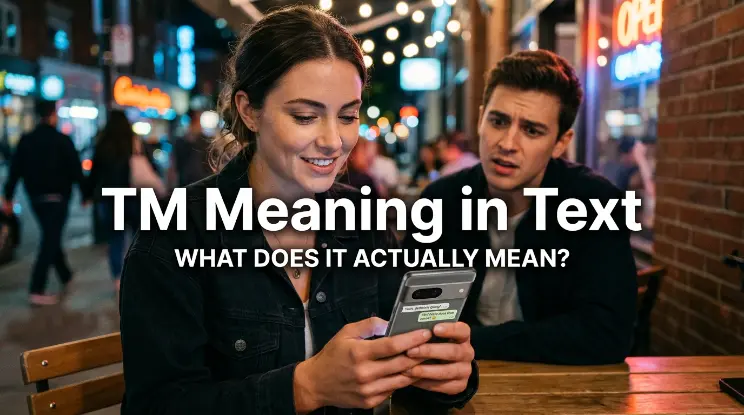
You’re scrolling through a chat and someone drops “tm” with zero explanation. Is it “trust me”? “Text message”? “Tomorrow”? Suddenly a two-letter abbreviation has you completely stuck, and scrolling back through the conversation doesn’t help much either.
People search for “tm meaning in text” because this short form pops up everywhere, texts, Instagram comments, Snapchat captions, group chats, and even the occasional office message, but it rarely means the exact same thing twice. Unlike a lot of internet slang, TM doesn’t have one fixed definition. Its meaning bends depending on who’s texting, what platform they’re on, and what the rest of the sentence says.
In this guide, you’ll learn every common meaning of TM, how to tell them apart using context, real examples from everyday conversations, where the abbreviation came from, and the small mix-ups people run into when using it. By the time you finish reading, you’ll be able to spot the right meaning instantly, no more guessing games.
Quick Answer
TM most commonly means “trust me” in casual texting and social media. It can also stand for “text message,” “tomorrow,” “too much,” or, in a completely different non-slang context, “trademark.” The surrounding words in the message usually reveal which meaning is intended.
What Does “TM” Mean?
At its core, TM is just a shortcut. It takes a longer phrase and squeezes it down into two letters so people can type faster and keep conversations moving.
The most widely recognized meaning in casual texting is “trust me.” People add it to a sentence when they want to sound confident or reassure someone that what they’re saying is true. It works almost like a verbal handshake, a small way of saying “believe me on this one.”
That said, TM isn’t locked into one single meaning. Depending on the sentence around it, it can also mean “text message,” “tomorrow,” or “too much.” There’s also a completely separate, non-slang use: the ™ symbol, which stands for “trademark” in business and legal writing.
Because the letters stay the same across all these meanings, context does almost all the heavy lifting. Reading the full sentence, not just the abbreviation, is the fastest way to figure out what someone actually means.
Meaning in Different Contexts
TM shows up across nearly every messaging platform, but the exact meaning can shift slightly depending on where you spot it.
Everyday Conversation
In face-to-face-style texting between friends, TM most often means “trust me.” It’s tacked onto the end of a sentence for emphasis, almost like saying “seriously” or “I promise.”
Text Messages
In regular SMS chats, TM can mean a few different things depending on tone. It might mean “trust me” when reassuring someone, “tomorrow” when making plans, or occasionally “text message” itself when talking about communication preferences.
Social Media
On Twitter/X and Facebook, TM often appears in comments reacting to something dramatic or emotional. Here, it frequently means “too much,” used to describe something overwhelming, intense, or over the top.
Since WhatsApp is often used for planning and everyday chatting, TM here leans toward “tomorrow” a lot of the time, especially in messages about schedules or meetups.
Snapchat
On Snapchat, TM commonly means “trust me” or “tomorrow,” depending on the caption or chat. Because Snapchat conversations are quick and often tied to daily plans or streaks, both meanings show up regularly.
In Instagram comments and DMs, TM tends to pop up as “too much” when reacting to a bold outfit, a dramatic story, or an impressive post, though “trust me” also appears often in more personal conversations.
TikTok
TikTok comment sections use TM in similar ways to other short-form platforms, often as “too much” for exaggerated reactions or “trust me” when backing up an opinion in the comments.
Gaming
In gaming chats, TM sometimes shows up as a quick way of saying “trust me” when giving advice or calling a play, since fast typing matters more than full sentences during a match.
Professional Communication
In workplace or business messages, TM almost always refers to “trademark,” especially when discussing branding, product names, or legal ownership. Casual slang meanings rarely belong in professional writing.
Internet Slang
Within the wider world of texting abbreviations, TM sits next to similar short forms like “fr” (for real) and “ngl” (not gonna lie), all used to add emphasis or save time while typing.
Examples of “TM”
Here are five real-life examples showing how TM shows up in different situations.
1. Sentence: “This café has the best coffee in town, tm.” Meaning: Trust me — the sender is reassuring the listener the claim is true. Situation: Recommending a place to a friend over text.
2. Sentence: “Let’s meet up tm at noon?” Meaning: Tomorrow — making plans for the next day. Situation: Two friends coordinating a get-together.
3. Sentence: “That finale was tm, I’m still not okay.” Meaning: Too much — expressing that something was emotionally overwhelming. Situation: Reacting to a TV show ending in a group chat.
4. Sentence: “Sorry, I only saw your tm an hour later.” Meaning: Text message — referring to the message itself. Situation: Apologizing for a late reply.
5. Sentence: “Make sure the new logo includes the TM symbol.” Meaning: Trademark — referring to legal branding protection. Situation: A workplace conversation about a company’s branding.
When Do People Use “TM”?
People use TM mostly in casual, fast-paced conversations where speed matters more than spelling everything out. It’s common in texting, social media comments, and messaging apps, especially among younger users who grew up shortening common phrases.
People typically reach for TM when they want to:
- Reassure someone that a statement is true (“trust me”)
- Make quick plans for the next day (“tomorrow”)
- React to something overwhelming or dramatic (“too much”)
- Refer to a message itself in casual conversation (“text message”)
- Discuss branding or legal ownership in professional writing (“trademark”)
The slang meanings work well in relaxed settings like group chats, DMs, and social media comments. The trademark meaning, on the other hand, belongs almost exclusively in business, legal, or marketing contexts. Mixing them up in the wrong setting can create real confusion, so paying attention to the conversation’s tone matters.
Different Meanings of “TM”
TM carries several distinct meanings depending on where and how it’s used. Here’s a breakdown of each one.
Meaning 1: Trust Me
- Definition: Used to reassure someone that a statement is genuine or reliable.
- Context: Casual texting, social media comments, everyday chats.
- Example: “It’s going to work out fine, tm.”
Meaning 2: Text Message
- Definition: Refers to the act of texting or to a message itself.
- Context: Casual conversations about communication habits, sometimes used by older texters.
- Example: “I prefer a tm over a phone call any day.”
Meaning 3: Tomorrow
- Definition: A quick way of referring to the next day.
- Context: Planning messages, scheduling, casual chats about upcoming plans.
- Example: “See you tm at the game.”
Meaning 4: Too Much
- Definition: Describes something excessive, overwhelming, or emotionally intense.
- Context: Social media reactions, dramatic or funny situations.
- Example: “That drama at work today was tm.”
Meaning 5: Trademark
- Definition: A legal symbol or term indicating brand ownership.
- Context: Business, marketing, legal documents.
- Example: “Our company name now has the TM symbol attached.”
Origin of “TM”
The abbreviation TM has actually existed for a long time outside of texting slang. The ™ symbol has been used in business and branding for decades to mark unregistered trademarks, long before texting culture ever picked up the letters.
As mobile messaging grew in the early 2000s, people began shortening common phrases to fit character limits and type faster. “Trust me,” being a phrase used constantly in everyday speech, was a natural candidate for shortening, and TM stuck.
Other meanings, like “tomorrow” and “too much,” developed the same way, simply as quick abbreviations for frequently typed words. Social media platforms with fast-scrolling comment sections helped these casual meanings spread even further, especially among younger users who valued speed and brevity in their replies.
There’s no single moment credited as the exact origin of the slang version. Like most texting abbreviations, TM evolved gradually through everyday use rather than being introduced by one specific event or platform.
Similar Words and Alternatives
If you come across TM often, it helps to know some related abbreviations that serve similar purposes.
- Fr (For Real): Used to express sincerity or agreement, similar to the “trust me” meaning of TM.
- Ngl (Not Gonna Lie): Adds honesty to a statement, often used the same way as TM’s reassurance meaning.
- Tmrw: A more literal shorthand for “tomorrow,” often used interchangeably with TM in planning messages.
- A Lot: A plain-language alternative to the “too much” meaning of TM, used when clarity matters more than slang.
- ™: The formal trademark symbol used in official branding and legal writing, distinct from the casual texting meanings.
While these terms overlap with TM in certain situations, none of them carry quite the same flexibility. TM’s biggest strength, and its biggest source of confusion, is that it can shift meaning entirely based on context.
Common Mistakes
Mistake 1: Assuming TM always means “trust me.” While it’s the most common meaning, TM can just as easily mean “tomorrow” or “too much” depending on the sentence. Always read the full message before assuming.
Mistake 2: Using slang TM in professional writing. In business emails or branding documents, TM almost always refers to trademark. Using it as casual slang in a formal setting can create confusion or seem unprofessional.
Mistake 3: Ignoring tone and context. Since TM has multiple meanings, ignoring the tone of a conversation can lead to a totally wrong interpretation. A dramatic reaction points to “too much,” while a scheduling message points to “tomorrow.”
Mistake 4: Confusing TM with similar-looking abbreviations. Abbreviations like “ty” (thank you) or “tbh” (to be honest) look similar at a glance but mean something completely different. Double-check before replying.
Mistake 5: Overusing it until it loses meaning. Adding “tm” to every single sentence can water down its impact, especially when it’s meant to add emphasis or reassurance. Save it for moments where it actually adds something.
Frequently Asked Questions
What does TM mean in texting?
TM most often means “trust me” in casual texting, though it can also mean “tomorrow,” “too much,” or “text message” depending on the context of the conversation.
Is TM the same as trademark?
Only in business, legal, or branding contexts. In casual texting and social media, TM almost always refers to slang meanings like “trust me” rather than the trademark symbol.
Is TM rude or offensive?
No, TM is a neutral abbreviation. It’s used to add emphasis, reassurance, or quick information, and doesn’t carry any negative or offensive meaning.
Can TM be used in professional messages?
Casual slang meanings should be avoided in professional writing. The trademark meaning, however, is completely appropriate in business, legal, or marketing communication.
How do I know which meaning of TM someone intends?
Look at the full sentence and the platform it’s used on. Planning messages usually mean “tomorrow,” dramatic reactions usually mean “too much,” and reassuring statements usually mean “trust me.”
Who uses TM the most?
TM is common across all age groups, but the slang meanings like “trust me” and “too much” are especially popular among teens and young adults on platforms like TikTok, Snapchat, and Instagram.
What should I reply if someone sends just “tm”?
If the meaning isn’t clear from earlier messages, it’s completely fine to ask “trust you on what?” or “you mean tomorrow?” to clarify before responding further.
Conclusion
TM is a flexible little abbreviation that can mean several different things depending on where you see it. In casual texting, it most often means “trust me,” but it can also stand for “tomorrow,” “too much,” or “text message.” In business and legal writing, it refers to “trademark” instead.
Because the same two letters cover so much ground, context is everything. Reading the full message, paying attention to tone, and considering the platform will almost always reveal which meaning someone intends.

Hi, I’m Ethan Carter, a writer at Meanhubz.com. I enjoy explaining words, phrases, slang, and everyday expressions in a simple and engaging way. My goal is to help readers understand language clearly, improve their English, and communicate with confidence through practical examples and easy-to-follow explanations.