If someone replied to your text with just a single closing parenthesis, like “)”, you’ve probably paused and wondered what it actually means. It looks incomplete, almost like part of an emoji got cut off, but it’s actually used on purpose by a lot of people. Understanding ) meaning in text message helps you read the tone behind it instead of feeling confused or ignored.
People search for this because a lone “)” doesn’t explain itself. It shows up in texting, DMs, and casual chats, often replacing a full smiley face. Depending on the person and the conversation, it can feel warm, awkward, or even a little flat.
In this article, you’ll learn what “)” means, how its tone shifts depending on context, real examples, where the habit came from, and how to avoid misreading it.
Quick Answer
A single “)” in a text message is shorthand for a smiley face, standing in for “:)” without the colon. It usually signals a small smile, light amusement, or friendly warmth. Depending on tone and relationship, it can feel affectionate, casual, or slightly awkward.
What Does “)” Mean?
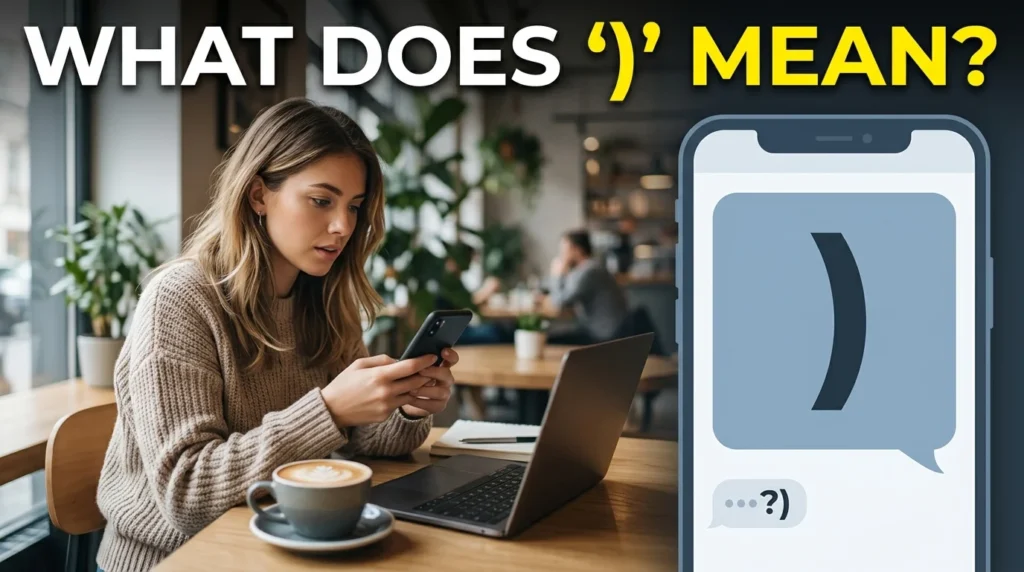
In plain English, a lone “)” is a simplified smiley face. It’s the second half of the classic “:)” emoticon, with the colon dropped to make it faster and easier to type.
The literal meaning is visual. A closing parenthesis on its own resembles the curve of a smile, similar to how “:)” represents a full smiling face made of two symbols.
The most common meaning is a soft, low-key smile. It’s usually friendly, sometimes shy or affectionate, and often used when a full smiley face would feel like too much effort or too formal for the moment.
Meaning in Different Contexts
The meaning of “)” stays fairly consistent, but its emotional weight can shift depending on who’s using it and how.
Everyday Conversation
In everyday texting, “)” is often used as a quiet, warm reaction, similar to a soft smile you might give someone in person rather than a big laugh.
Text Messages
In texting specifically, “)” is common as a quick way to end a message on a friendly, positive note without needing a full sentence or emoji.
Social Media
On social media, a lone “)” is less common in public posts but sometimes appears in comments or replies as a subtle, understated reaction.
In WhatsApp chats, “)” often shows up at the end of a message, especially among people who text frequently and prefer a simple, minimal way to express warmth.
Snapchat
On Snapchat, “)” is occasionally used in chat replies, usually as a quick, casual way to react positively without sending a full emoji.
In Instagram DMs, “)” sometimes appears as a subtle, friendly closer to a message, especially in more personal or flirty conversations.
TikTok
On TikTok, “)” is less common in public comments but can appear in direct messages between users who know each other well.
Gaming
In gaming chats, “)” is rare, though it can occasionally appear as a quick, low-effort way to acknowledge something positively during a conversation.
Professional Communication
A lone “)” should be avoided in professional communication. It can look like a typo or unfinished thought to someone unfamiliar with the habit, so it’s best to use full words or standard emoticons in formal settings.
Internet Slang
As a texting habit, “)” isn’t officially “slang” in the traditional sense, but it’s a widely recognized shorthand, especially popular in cultures and communities where minimal, low-effort emoticons are common.
Examples of “)”
Here are real-life examples showing how “)” is used in conversation.
Example 1: “Made it home safe )” Meaning: A soft, reassuring smile. Situation: Letting someone know you’re okay after a trip or outing.
Example 2: “Miss you )” Meaning: A gentle, affectionate tone. Situation: A message between close friends or a partner expressing warmth.
Example 3: “lol that’s funny )” Meaning: A light, amused reaction. Situation: Reacting casually to something entertaining in a chat.
Example 4: “Sounds good, see you then )” Meaning: A friendly confirmation. Situation: Agreeing to plans in a warm, casual way.
Example 5: “okay )” Meaning: Could be warm or slightly flat, depending on tone. Situation: A short reply that might feel affectionate or a little distant, depending on the rest of the conversation.
When Do People Use “)”?
A lone “)” tends to show up in relaxed, personal conversations rather than public or formal ones.
Common situations include:
- Ending a message on a warm or friendly note
- Reacting mildly to something positive or funny
- Replacing a full smiley face for speed or simplicity
Who uses it: People who text frequently and prefer minimal typing, as well as users from regions and online communities where this shorthand smiley is especially common.
Why people use it: It’s fast, low-effort, and still gets a friendly, positive tone across without needing extra characters or a full emoji.
Appropriate situations: Casual texting, personal chats with friends or partners.
Inappropriate situations: Professional emails, formal messages, or conversations with people who might not recognize it as a smiley and could misread it as a typo.
Different Meanings of “)”
While “)” generally means a smile, its emotional tone can shift depending on context.
1. Warm, Affectionate Smile Definition: A gentle, caring tone, often used with close friends or partners. Context: Personal, intimate conversations. Example: “Goodnight )”
2. Light, Casual Reaction Definition: A mild, friendly response to something funny or pleasant. Context: Everyday casual texting. Example: “haha true )”
3. Short or Slightly Flat Reply Definition: A brief response that can feel a little distant or low-energy, depending on the rest of the conversation. Context: Quick replies without much elaboration. Example: “okay )”
Reading which meaning applies usually depends on the message length, punctuation, and the overall emotional tone of the conversation.
Origin of “)”
The habit of using “)” alone as a smiley face grew out of the same emoticon culture that created “:)” and other classic text-based expressions. As typing became faster and more casual, especially in instant messaging, some users started dropping the colon entirely, since the closing parenthesis alone still visually resembles a smile.
This shorthand became especially popular in certain online communities and regions where quick, minimal typing is common in everyday texting, eventually spreading more broadly as a recognizable, casual way to end a message warmly.
There’s no single confirmed inventor of this specific habit. Like most emoticon shorthand, it developed naturally through everyday texting as people looked for faster ways to express a smile.
Similar Words and Alternatives
A few other symbols and expressions carry a similar meaning to a lone “)”.
- “:)” – The full classic smiley face, slightly more universally recognized.
- “))” – A doubled version sometimes used to express a bigger or more enthusiastic smile.
- “^^” – A different emoticon style representing closed, happy eyes, often used similarly.
- 🙂 (slight smile emoji) – A modern emoji alternative carrying a similar warm, understated tone.
- “heh” / “lol” – Text-based alternatives that convey light amusement without using a symbol at all.
The main difference between these is subtlety. A lone “)” tends to feel quieter and more minimal than a full emoji or “lol,” which can come across as more expressive or energetic.
Common Mistakes
A few misunderstandings happen with “)” so here’s how to avoid them.
Mistake 1: Mistaking “)” for a typo or unfinished message. Correct approach: Recognize it as a simplified smiley, especially if the person uses it consistently in their texting style.
Mistake 2: Assuming “)” always means the same emotional intensity. Correct approach: Pay attention to the rest of the message and relationship, since it can range from warm and affectionate to simply casual.
Mistake 3: Using “)” in professional communication. Correct approach: Avoid it in formal settings, since it can easily be misread as a mistake by someone unfamiliar with the habit.
Tip: If you’re unsure how someone means their “)” try looking at their overall texting style. If they use it often and consistently, it’s likely just a natural part of how they express warmth in writing.
Frequently Asked Questions
What does a single “)” mean in a text?
It’s shorthand for a smiley face, similar to “:)” but without the colon, usually signaling a small, warm smile.
Is “)” the same as a full smiley face?
It carries a similar meaning but often feels more minimal and low-key compared to a full “:)” or emoji.
Why do some people use “)” instead of a full emoji?
It’s faster to type and still clearly communicates a friendly, positive tone without needing extra characters.
Can “)” mean something negative?
Not usually. It’s almost always used positively, though a very short message ending in “)” can occasionally feel a bit flat depending on context.
Is it okay to use “)” in professional messages?
No. It’s best reserved for casual, personal conversations, since it can be misread as a typo in formal communication.
Where did the habit of using “)” alone come from?
It grew out of general emoticon culture, where people gradually dropped the colon from “:)” for faster, more casual typing.
How do I know if someone means “)” warmly or just casually?
Look at the rest of the message and how often they use it. Consistent use usually signals a natural part of their texting style rather than a special reaction.
Conclusion
A single “)” in a text message is a simplified smiley face, standing in for the classic “:)” without the colon. It usually signals a small, warm smile, though its tone can range from affectionate to casual depending on the conversation and relationship.
The key takeaway with ) meaning in text message is that context and consistency matter. If someone uses it often, it’s likely just part of their natural texting style rather than something to overanalyze. Once you recognize it as a smiley shorthand, you’ll be able to read the warmth behind it instead of feeling confused.

Hi, I’m Lucas Morgan, a writer at Meanhubz.com. I enjoy exploring words, phrases, idioms, and everyday expressions and explaining them in simple language. My goal is to create clear, engaging, and useful content that helps readers improve their English, understand meanings easily, and communicate with greater confidence every day.