Ever received a text message with an abbreviation you could not understand? Modern texting is full of shortcuts, and DND meaning in text is worth knowing because it can explain why someone is unavailable or does not respond immediately. DND most commonly stands for “Do Not Disturb.” People use it when they want some quiet time, need to focus on work or studying, or prefer not to receive calls and messages for a while.
For example, a friend might text, “I’m putting my phone on DND, talk later,” to let you know they will not be available. The abbreviation is also used in phone settings, where Do Not Disturb mode can silence notifications and calls according to the device’s settings.
On Snapchat, Instagram, WhatsApp, and other messaging platforms, someone may mention DND to communicate that they need privacy or a break from conversations. However, the exact meaning still depends on context. In gaming communities, DND can also refer to Dungeons & Dragons, a popular tabletop role-playing game. Understanding the conversation helps you identify which meaning applies.
Quick Answer
DND most commonly stands for “Do Not Disturb.” It’s used to let someone know you’re busy, unavailable, or intentionally avoiding messages and notifications for a while. It’s practical rather than rude, and it’s commonly used across texting apps, social media, and phone settings. In gaming and online communities, DND can also refer to “Dungeons & Dragons,” the popular tabletop role-playing game, which is a completely unrelated meaning.
What Does “DND” Mean?
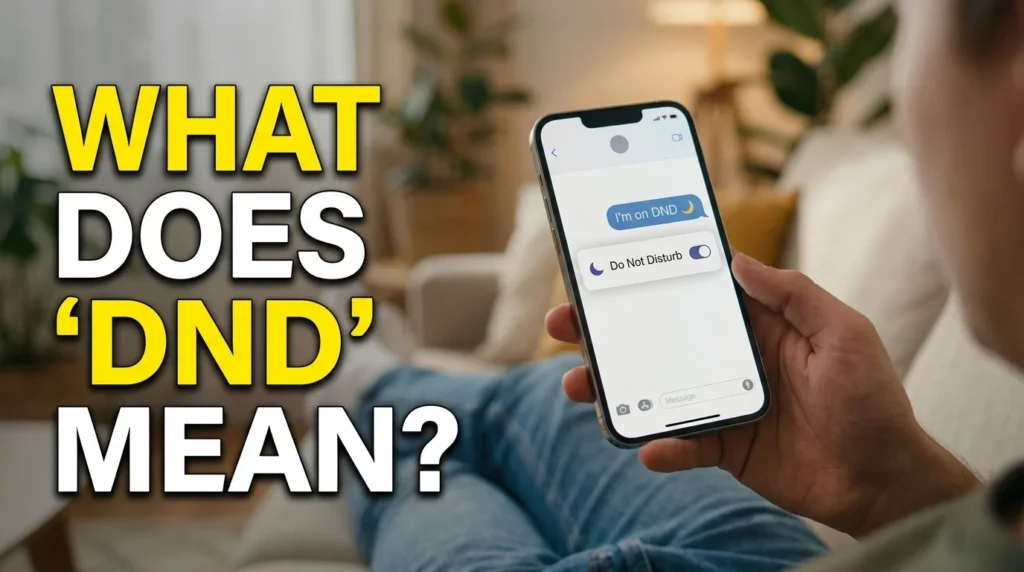
At its core, DND is short for “Do Not Disturb.” It’s used to signal that someone is temporarily unavailable and doesn’t want to be interrupted by messages, calls, or notifications.
Think of it as a digital version of hanging a “do not disturb” sign on a door. It’s a quick, clear way to set a boundary around your time without having to type out a full explanation every time.
The letter breakdown is simple:
- D = Do
- N = Not
- D = Disturb
Put together, DND reads exactly like the phrase it represents. It’s one of the more literal and widely understood pieces of texting slang, since its meaning translates directly from the full phrase without much room for confusion.
Meaning in Different Contexts
DND stays fairly consistent in meaning across most platforms, though tone can shift depending on how it’s used. Here’s how it typically shows up.
Everyday Conversation
In everyday talk, DND is used to explain why someone hasn’t been responding, or to give a heads-up that they’re about to be unavailable for a while.
Text Messages
This is one of the most common places to see DND. People send it to explain a delayed reply or to signal they need uninterrupted time.
Social Media
On platforms like X (formerly Twitter) and Facebook, DND sometimes appears in posts or bios, letting followers know someone is stepping away from notifications or messages for a bit.
In WhatsApp chats, DND is used the same way as regular texting, often paired with the app’s actual “Do Not Disturb” notification setting.
Snapchat
On Snapchat, DND fits naturally into quick, casual updates, letting friends know someone is taking a break from their phone or focusing on something else.
You’ll sometimes see DND in Instagram captions or Stories, especially from creators explaining they’re stepping away from DMs to focus on other things.
TikTok
In TikTok comments or captions, DND occasionally appears when creators mention needing a break from constant notifications while filming or editing.
Gaming
In gaming communities, especially on Discord, Reddit, and Twitch, DND frequently refers to “Dungeons & Dragons,” the tabletop role-playing game, rather than “Do Not Disturb.” Context makes this meaning clear quickly.
Professional Communication
DND is actually quite common and acceptable in professional settings, since it clearly communicates that someone is focused or unavailable without sounding rude. It’s often used alongside “Do Not Disturb” status features in workplace messaging tools.
Internet Slang
Within the wider world of internet slang, DND sits alongside other status-related abbreviations like “BRB” (be right back) and “AFK” (away from keyboard), all used to signal availability.
Examples of “DND”
Here are five real-life examples showing how DND is actually used in conversations.
Example 1 Sentence: “Can you call me now?” — “Sorry, I’m DND right now. Will call you back later.” Meaning: Currently unavailable, don’t contact right now. Situation: Someone explains they can’t take a call at the moment.
Example 2 Sentence: “Going DND for 2 hours to finish this project.” Meaning: Temporarily unavailable to focus on work. Situation: Someone signals they need uninterrupted time to concentrate.
Example 3 Sentence: “Why aren’t you replying?” — “Was in DND, just free now!” Meaning: Explaining a delayed response. Situation: Someone catches up on messages after finishing a task.
Example 4 Sentence: “On DND finishing my project, talk later.” Meaning: Focused and unavailable for the moment. Situation: A quick heads-up before going silent for a while.
Example 5 Sentence: “Our DND campaign continues tonight, who’s in?” Meaning: Dungeons & Dragons (the tabletop game). Situation: Friends planning to play their ongoing D&D campaign.
When Do People Use “DND”?
DND shows up in fairly predictable situations, almost always tied to needing space, focus, or privacy.
Common situations include:
- Explaining why you haven’t replied to messages
- Signaling you need uninterrupted time to work or study
- Letting friends know you’re taking a break from your phone
- Setting a boundary around your availability
- Referring to a Dungeons & Dragons session (in gaming contexts)
Who uses it: DND is used across a wide range of ages, from teens managing social notifications to professionals signaling focus time at work.
Why people use it: It’s a quick, clear, and generally accepted way to communicate unavailability without needing to over-explain.
Appropriate situations: Casual texts, workplace messaging, social media updates, and gaming chats.
Inappropriate situations: There aren’t many situations where DND itself is inappropriate, though sending only “DND” with no context in response to something urgent or emotional can come across as abrupt.
Different Meanings of “DND”
While “Do Not Disturb” is by far the most common meaning in everyday texting, DND has one other well-established meaning depending on the context.
Meaning 1: Do Not Disturb (Primary Meaning)
- Definition: A signal that someone is busy, unavailable, or intentionally avoiding interruptions.
- Context: Texting, social media, workplace messaging, phone settings.
- Example: “I’m DND until this meeting wraps up.”
Meaning 2: Dungeons & Dragons
- Definition: A popular tabletop fantasy role-playing game.
- Context: Gaming communities, Discord servers, tabletop gaming groups.
- Example: “Our DND session got pushed to Saturday.”
Because these two meanings are so different, context makes it easy to tell them apart almost instantly. A conversation about availability or notifications means “Do Not Disturb,” while a conversation about characters, campaigns, or gaming sessions means “Dungeons & Dragons.”
Origin of “DND”
The “Do Not Disturb” meaning of DND traces back to hotel etiquette, where guests would hang a small “DND” sign or tag on their door to prevent housekeeping or staff from interrupting them. This simple, practical signal became widely recognized well before texting existed.
As smartphones developed, tech companies adopted the same concept, building “Do Not Disturb” directly into phone settings to silence calls and notifications. From there, internet users shortened the phrase into casual texting slang, using “DND” even outside of the actual phone feature to describe general unavailability.
The “Dungeons & Dragons” meaning has a completely separate origin, coming directly from the tabletop role-playing game created in the 1970s, which built a massive, dedicated community that continues to use “DND” as a natural shorthand today. Both meanings have stayed relevant for decades because they solve two very different, ongoing needs: managing digital attention and referring to a beloved long-running game.
Similar Words and Alternatives
DND belongs to a group of availability and status-related texting slang. Here are some related terms and how they compare.
- BRB (Be Right Back): Suggests a short, temporary break rather than a longer stretch of unavailability.
- AFK (Away From Keyboard): Common in gaming, indicating someone has stepped away temporarily.
- Busy right now: A fully spelled-out, slightly more formal way to express the same idea as DND.
- On silent: Describes muted notifications without necessarily meaning someone is unavailable to reply eventually.
- Can’t talk rn: A casual, immediate way of saying the same thing as DND in a specific moment.
The biggest difference between these alternatives is duration and tone. DND tends to imply a longer, more intentional stretch of unavailability, while “BRB” and “AFK” usually suggest a quick, short break. “Busy right now” and “can’t talk rn” are more situational and immediate compared to the broader, more general nature of DND.
Common Mistakes
Here are a few common ways people misread or misuse DND.
Mistake 1: Assuming DND is rude. DND is almost always practical rather than dismissive. It simply communicates unavailability, not annoyance or anger.
Mistake 2: Confusing the two meanings. In gaming spaces, DND usually means “Dungeons & Dragons,” not “Do Not Disturb.” Always check the topic of conversation before assuming which meaning applies.
Mistake 3: Sending only “DND” without context in urgent situations. A bare “DND” reply to something serious or emotional can feel cold. Adding a little more context (“DND right now, but I’ll call you in an hour”) keeps the tone warmer.
Mistake 4: Pushing someone who’s on DND to respond anyway. Since DND is meant to set a boundary, ignoring it and continuing to message someone can come across as inconsiderate. It’s best to respect the signal and wait.
Tip to avoid confusion: Check the context of the conversation. Everyday texting almost always means “Do Not Disturb,” while gaming or tabletop-related chats usually mean “Dungeons & Dragons.”
Frequently Asked Questions
What does DND mean in a text message?
DND most commonly stands for “Do Not Disturb,” used to signal that someone is busy or unavailable and doesn’t want to be interrupted.
Is DND rude to say?
No, it’s generally seen as a practical, direct way to communicate unavailability rather than something rude or dismissive.
Does DND ever mean something else?
Yes, in gaming and tabletop communities, DND often refers to “Dungeons & Dragons,” the popular role-playing game, which is unrelated to the “Do Not Disturb” meaning.
Where did DND come from?
The “Do Not Disturb” meaning traces back to hotel door signs, later adopted by smartphones as a notification-silencing feature before becoming casual texting slang.
Can I use DND in a professional setting?
Yes, DND is widely accepted in professional and workplace communication, especially when signaling focus time or unavailability during meetings or deep work.
How do I know which meaning of DND is intended?
Context makes it clear. Conversations about notifications or availability mean “Do Not Disturb,” while gaming-related conversations usually mean “Dungeons & Dragons.”
Is DND still commonly used today?
Yes, DND remains extremely common across texting, social media, and workplace communication, especially as digital boundary-setting becomes more of a priority for many people.
Conclusion
DND is a simple, practical piece of texting shorthand that most commonly means “Do Not Disturb,” used to signal that someone is busy or unavailable and would rather not be interrupted. It’s direct without being rude, and it’s widely accepted across casual, social, and even professional conversations.
You’ll see it most often in texts, social media updates, and workplace messaging, and it’s worth remembering that in gaming communities, DND often refers to “Dungeons & Dragons” instead. Because the two meanings are so different, context makes it easy to tell which one applies.

Hi, I’m William Brooks, a writer at Meanhubz.com. I’m passionate about making English words, phrases, idioms, and expressions easy to understand. I create clear, accurate, and engaging content with simple examples to help students, writers, and English learners improve their vocabulary and communicate with greater confidence in everyday life.