If you’ve seen “STFU” in a text, a comment, or a group chat and wanted to know exactly what it means, you’re not alone. This is one of the most recognized abbreviations online, but it can carry different levels of intensity depending on who’s saying it and why. Understanding stfu meaning in text helps you read tone correctly and know when it’s playful versus when it’s genuinely harsh.
People search for this term because context changes everything here. Among close friends, it can be a joke. In an argument, it can be a serious insult. It shows up in texting, gaming, social media, and casual conversation, and knowing the difference matters.
In this article, you’ll learn what STFU means, how its tone shifts across different situations, real examples, where it came from, and how to avoid using it the wrong way.
Quick Answer
STFU stands for “Shut The F* Up.”** It’s a strong, informal phrase used to tell someone to stop talking. Depending on tone and relationship, it can be a joking reaction between friends or a genuinely rude, aggressive comment in an argument.
What Does “STFU” Mean?
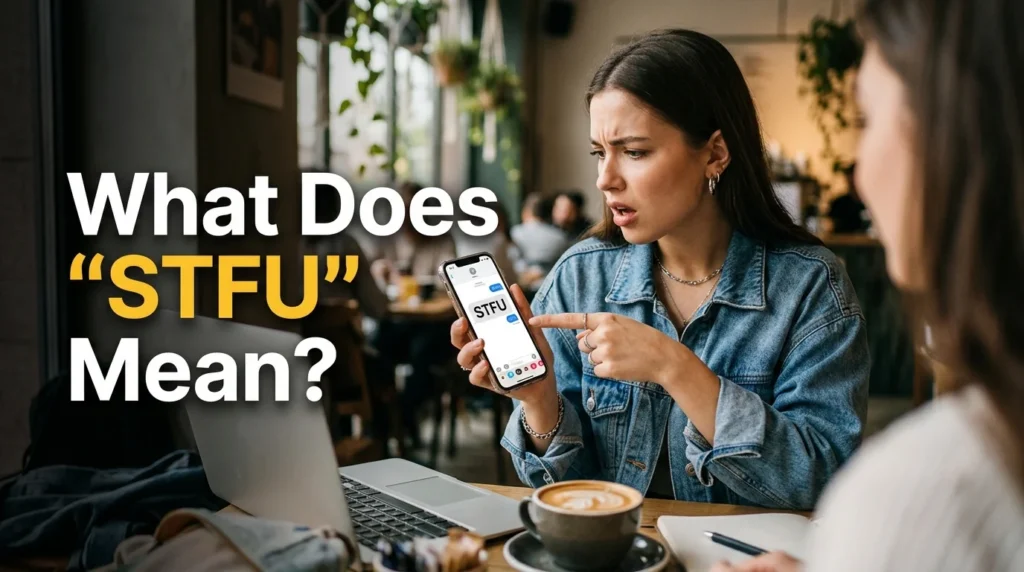
In plain English, STFU means “Shut The F*** Up.” It’s an abbreviation for a phrase that tells someone, bluntly and forcefully, to stop talking.
The literal meaning is direct: it’s a command to be quiet, using strong language to add emphasis. It’s considered vulgar because of the swear word it includes, even though the letters are abbreviated.
The most common meaning is straightforward, but the tone behind it can range widely. Sometimes it’s used harshly to shut someone down in an argument. Other times, it’s used jokingly, almost like saying “no way” or “stop it” in reaction to surprising or funny news.
Because of this range, reading the context around STFU is more important than the phrase itself.
Meaning in Different Contexts
STFU keeps the same core meaning everywhere, but the tone and intent shift a lot depending on the setting.
Everyday Conversation
In spoken conversation between close friends, “shut up” (and by extension, STFU in text form) is sometimes used casually to react to surprising or exciting news, similar to saying “no way” or “you’re joking.”
Text Messages
In texting, STFU often appears as a playful reaction to shocking, funny, or unexpected news between friends, though it can also be used seriously during an argument or heated exchange.
Social Media
On social media, STFU frequently shows up in comment sections, sometimes jokingly reacting to a funny post, and other times aggressively directed at someone during a disagreement or debate.
In WhatsApp group chats, STFU is often used lightly among friends reacting to a funny message or unbelievable story, especially in casual, close-knit group settings.
Snapchat
On Snapchat, STFU commonly appears as a quick, informal reaction to surprising content shared between friends, usually in a joking tone rather than a hostile one.
On Instagram, STFU shows up in comments both playfully (reacting to funny or shocking content) and negatively (as a rude response during arguments or disagreements).
TikTok
On TikTok, STFU is often used in comments reacting to unbelievable videos, typically in a lighthearted, exaggerated way rather than as a genuine insult.
Gaming
In gaming chats, STFU is frequently used more aggressively, often during heated moments, disagreements, or frustration between players, and can come across as genuinely rude depending on tone.
Professional Communication
STFU should never be used in professional or formal communication. It’s considered vulgar and inappropriate in any workplace or business setting.
Internet Slang
As internet slang, STFU has become one of the most widely recognized abbreviations, understood across nearly every platform and generation active online.
Examples of “STFU”
Here are real-life examples showing how STFU is used in different tones and situations.
Example 1: “Wait you got the job?? STFU that’s amazing!!” Meaning: Playful excitement, similar to “no way!” Situation: A friend reacting happily to good news in a text.
Example 2: “STFU, nobody asked for your opinion.” Meaning: A genuinely rude command to stop talking. Situation: Someone being harsh during a heated argument.
Example 3: “stfu that video is so funny 😂” Meaning: Playful reaction to something entertaining. Situation: A comment under a funny social media post.
Example 4: “can everyone stfu, trying to focus on this round” Meaning: A frustrated request for quiet. Situation: A gamer asking teammates to stop talking during an intense match.
Example 5: “You got engaged?! STFU I’m so happy for you!” Meaning: Excited disbelief, used affectionately. Situation: A friend reacting to exciting personal news.
Example 6: “STFU and mind your own business.” Meaning: A hostile, dismissive comment. Situation: Someone responding aggressively during an online disagreement.
When Do People Use “STFU”?
STFU shows up in a wide range of emotional situations, from excitement to genuine anger.
Common situations include:
- Reacting to shocking or exciting news among friends
- Telling someone to stop talking during an argument
- Expressing frustration in gaming or group chats
Who uses it: Mostly teens and young adults, though it’s widely recognized and used across many age groups in casual online spaces.
Why people use it: It’s a quick, forceful way to express either strong excitement or strong frustration, depending entirely on the tone of the conversation.
Appropriate situations: Casual texting between close friends, joking reactions to surprising news.
Inappropriate situations: Professional settings, conversations with people you don’t know well, or any situation involving someone who might find the language genuinely upsetting or disrespectful.
Different Meanings of “STFU”
While STFU has one literal meaning, it’s used with two very different intentions depending on the situation.
1. Playful Reaction Definition: An exaggerated, joking way to react to surprising or exciting news. Context: Texting or social media between friends. Example: “STFU you’re kidding, that’s impulsive!”
2. Genuine Command to Stop Talking Definition: A serious, often rude demand for someone to be quiet. Context: Arguments, disagreements, or frustrated exchanges. Example: “STFU, I don’t want to hear it.”
Recognizing which meaning applies depends entirely on the relationship between the people talking and the tone of the overall conversation.
Origin of “STFU”
STFU is one of many abbreviations that grew out of early internet chatroom and forum culture, where users shortened common phrases to type faster. As texting became widespread, especially with character limits on early messaging platforms, similar abbreviations became common shorthand.
The phrase itself, “shut the f*** up,” has existed in spoken language for a long time. The abbreviation naturally developed once online communication started favoring speed and shorthand over full sentences.
Over time, STFU became one of the most recognized pieces of internet slang, spreading across chatrooms, texting, gaming platforms, and eventually social media, where it’s now used in both hostile and joking ways.
There’s no single confirmed origin point or inventor. Like most internet abbreviations, it developed naturally through widespread, repeated use rather than being created by one specific person or platform.
Similar Words and Alternatives
A few other phrases and abbreviations carry a similar tone or meaning to STFU.
- “Shut up” – A softer, less vulgar version of the same basic message.
- STFU up variations like “STFUUU” – Often used to add extra emphasis, usually in a playful, exaggerated tone.
- “No way” / “Shut the front door” – Softer, non-vulgar alternatives used to express the same disbelief without strong language.
- GTFO – “Get the f*** out,” a related phrase used to tell someone to leave rather than stop talking.
- STFDU – A less common variation adding “down” for extra emphasis, though it’s used far less frequently.
The main difference between these terms is intensity. STFU is stronger and more vulgar than “shut up,” while phrases like “no way” offer a milder way to express the same surprise without strong language.
Common Mistakes
A few mix-ups happen with STFU, so here’s how to avoid confusion.
Mistake 1: Assuming STFU is always meant as an insult. Correct approach: Pay attention to context. Among friends, it’s often used playfully rather than aggressively.
Mistake 2: Using STFU with someone you don’t know well. Correct approach: Avoid using it outside close, casual friendships, since it can easily come across as disrespectful to someone unfamiliar with your tone.
Mistake 3: Using STFU in professional or formal settings. Correct approach: Never use it in workplace communication, since it’s vulgar and inappropriate for professional conversations.
Tip: If you’re unsure how a message will be received, it’s safer to use a milder phrase instead, especially in text where tone can be easily misread.
Frequently Asked Questions
What does STFU stand for?
STFU stands for “Shut The F*** Up,” a strong phrase used to tell someone to stop talking.
Is STFU always meant as an insult?
Not always. Among close friends, it’s often used playfully to react to surprising or exciting news, though it can also be used seriously during arguments.
Is STFU appropriate to use with strangers?
No. It’s best reserved for casual conversations with close friends, since it can easily be misunderstood or seen as disrespectful by people you don’t know well.
Can STFU be used in professional settings?
No. STFU is considered vulgar slang and should never be used in workplace or formal communication.
What’s a softer alternative to STFU?
“Shut up” is a milder version, while phrases like “no way” or “shut the front door” offer a non-vulgar way to express the same surprise.
How do I know if someone means STFU jokingly or seriously?
Look at the relationship and the overall tone of the conversation. Exclamation points, emojis, and excited context usually signal a playful use, while short, blunt messages during disagreements usually signal a serious one.
Is STFU a recent term?
No. It’s been widely used in online communication for a long time, growing out of early chatroom and texting culture as a fast way to type a common phrase.
Conclusion
STFU stands for “Shut The F*** Up,” a strong and widely recognized phrase used to tell someone to stop talking. Its meaning stays the same, but its tone shifts a lot depending on the situation, ranging from a playful reaction between friends to a genuinely harsh comment during an argument.
The key takeaway with stfu meaning in text is that context and relationship matter more than the phrase itself. Before reacting to it, or using it yourself, it helps to consider who’s saying it, why, and how well you know them. Once you understand these different tones, you’ll be able to read STFU correctly no matter where you see it.
Meta Description

Hi, I’m Lucas Morgan, a writer at Meanhubz.com. I enjoy exploring words, phrases, idioms, and everyday expressions and explaining them in simple language. My goal is to create clear, engaging, and useful content that helps readers improve their English, understand meanings easily, and communicate with greater confidence every day.