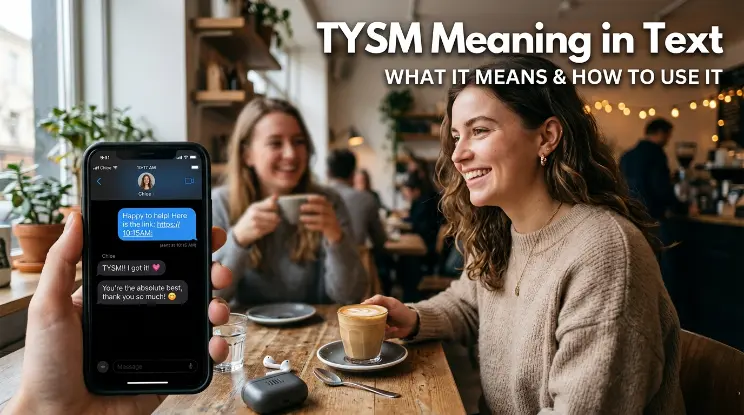
A friend does something kind, like covering your coffee or helping you move, and you text back “tysm.” It’s short, it’s warm, and it gets the point across instantly. But if you’ve never seen it before, those four letters might leave you pausing for a second.
People search for “tysm meaning in text” because this abbreviation shows up constantly in texts, comments, and DMs, almost always tied to genuine gratitude. Unlike a lot of slang that carries hidden layers or shifting meanings, TYSM is refreshingly simple, it means exactly what it looks like it might mean.
In this guide, you’ll learn exactly what TYSM stands for, how it’s used across different platforms, real examples from everyday conversations, where the term came from, and the small mistakes people make when using it. By the end, you’ll be using it naturally and reading it with total confidence.
Quick Answer
TYSM stands for “thank you so much.” It’s a warm, casual way to express strong gratitude in texting and online conversations. It carries more emphasis than a simple “thanks” or “ty,” showing genuine appreciation in a quick, friendly format.
What Does “TYSM” Mean?
TYSM is short for “thank you so much.” There’s no hidden meaning or twist here, it’s simply a faster way to type out heartfelt thanks in a text message or online conversation.
Adding “so much” to a thank you makes it feel warmer and more sincere than a plain “thanks.” When people type TYSM instead of just “ty,” they’re usually signaling that their appreciation goes a little deeper, whether that’s for a favor, a kind gesture, help with something, or just a thoughtful comment.
TYSM sits comfortably between a casual “thanks” and something more intense like “ILYSM” (I love you so much). It’s warm without being overly dramatic, making it a versatile way to show appreciation in almost any casual conversation.
Occasionally, TYSM gets used sarcastically, especially when someone’s frustrated or annoyed about something. In those cases, tone and context make the sarcasm pretty clear, since the words themselves stay exactly the same.
Meaning in Different Contexts
TYSM’s core meaning stays the same everywhere, though its emotional weight can shift slightly depending on the conversation.
Everyday Conversation
In casual texting between friends, TYSM usually expresses genuine appreciation for something small or thoughtful, like a favor, gift, or kind comment.
Text Messages
In regular SMS chats, TYSM often follows a favor or piece of help, showing warmer gratitude than a quick “thanks” would convey.
Social Media
On platforms like Twitter/X, Instagram, and Facebook, TYSM frequently appears in comments and replies, thanking followers, friends, or strangers for kind words or support.
In WhatsApp chats, TYSM is commonly used in personal conversations, especially when thanking friends or family for help, gifts, or thoughtful gestures.
Snapchat
On Snapchat, TYSM often shows up in quick replies, expressing appreciation for a compliment, favor, or thoughtful snap.
In Instagram comments and DMs, TYSM is used often to thank followers for birthday wishes, compliments, or support on a post.
TikTok
TikTok comment sections use TYSM a lot, especially when creators thank viewers for kind comments, shares, or reaching a milestone.
Gaming
In gaming chats, TYSM sometimes shows up when thanking teammates for help during a match, like a well-timed assist or good advice.
Professional Communication
TYSM is generally too casual for professional emails or formal messages. In workplace settings, phrases like “I truly appreciate it” or “thank you very much” come across as more polished.
Internet Slang
Within internet slang, TYSM sits alongside similar gratitude expressions like “ty” (thank you) and “tq” (thank you), all used to express appreciation quickly in casual digital conversation.
Examples of “TYSM”
Here are five real-life examples showing how TYSM actually gets used in conversation.
1. Sentence: “You picked up my shift? TYSM, you’re a lifesaver.” Meaning: Genuine gratitude for a helpful favor. Situation: Thanking a coworker or friend for covering a task.
2. Sentence: “TYSM for the birthday wishes everyone! 🥹” Meaning: Expressing appreciation to a group or audience. Situation: Responding to birthday messages on social media.
3. Sentence: “TYSM for helping me study, I actually understood it this time.” Meaning: Sincere thanks for meaningful help. Situation: Thanking a friend after a study session.
4. Sentence: “Oh, TYSM for reminding me five minutes before the deadline.” Meaning: Used sarcastically to express mild frustration. Situation: Reacting to a late or unhelpful reminder.
5. Sentence: “TYSM for the gift, I love it so much!” Meaning: Genuine appreciation for a thoughtful gesture. Situation: Thanking someone for a present.
When Do People Use “TYSM”?
People typically use TYSM in casual, warm conversations, mostly in texting, social media comments, and messaging apps. It’s especially common among younger users, though it’s widely understood and used across nearly all age groups.
People reach for TYSM when they want to:
- Express strong appreciation for a favor or gesture
- Thank someone warmly without writing a long message
- Respond to compliments, gifts, or kind comments
- Show gratitude to a group, like followers or friends
- Occasionally express sarcasm about a frustrating situation
TYSM fits naturally into relaxed, friendly conversations across nearly every platform. It’s less appropriate for formal or professional writing, where fully spelling out “thank you so much” or “I truly appreciate it” tends to feel more polished.
Different Meanings of “TYSM”
Unlike a lot of internet slang, TYSM doesn’t really carry multiple unrelated meanings. Its meaning stays completely consistent, though the tone behind it can shift depending on context.
Meaning 1: Thank You So Much (Sincere Gratitude)
- Definition: Expresses genuine, warm appreciation.
- Context: Personal conversations, social media, everyday texting.
- Example: “TYSM for being there for me today.”
Meaning 2: Thank You So Much (Sarcastic Use)
- Definition: Used ironically to express mild frustration or annoyance.
- Context: Reacting to something unhelpful or inconvenient.
- Example: “TYSM for canceling on me last minute.”
There’s no separate, unrelated meaning behind TYSM outside of these two tonal variations. The words stay exactly the same, it’s the surrounding context and tone that reveal whether someone means it sincerely or sarcastically.
Origin of “TYSM”
TYSM grew out of early internet chatrooms and SMS culture in the late 1990s and early 2000s, a time when character limits and slower typing methods pushed people to shorten common phrases wherever possible.
Alongside other well-known abbreviations like LOL (laugh out loud), BRB (be right back), and TY (thank you), TYSM naturally emerged as a slightly more emphatic way to say thanks without typing out the full phrase.
As texting and social media grew, TYSM spread widely across platforms, becoming one of the most universally recognized gratitude abbreviations online. Its popularity has stayed steady over the years, largely because it expresses something people say constantly in everyday life, appreciation, without needing any explanation once someone learns what it stands for.
Unlike many slang terms, TYSM hasn’t picked up alternate or twisted meanings over time. It remains almost entirely positive and sincere, aside from the occasional sarcastic use.
Similar Words and Alternatives
If TYSM comes up often in your conversations, these related expressions carry a similar meaning.
- TY (Thank You): A shorter, slightly less emphatic version of TYSM.
- TQ (Thank You): Another short variation, functionally similar to TY and TYSM.
- Appreciate you: A warm, modern alternative that conveys similar sincerity.
- Thanks a ton: A casual, non-abbreviated way to express strong gratitude.
- ILYSM (I Love You So Much): A more intense expression of appreciation, often used for closer relationships.
While these alternatives express similar gratitude, TYSM strikes a nice balance, warmer than a simple “thanks,” but not as intense as something like ILYSM, which makes it a versatile go-to for everyday appreciation.
Common Mistakes
Mistake 1: Using TYSM in professional writing. TYSM is casual slang, so it’s best avoided in workplace emails or formal messages. Phrases like “thank you very much” or “I truly appreciate it” fit better in those settings.
Mistake 2: Missing sarcastic tone. Since TYSM can occasionally be used sarcastically, missing that tone in a tense conversation could lead to a misunderstanding. Reading the full context helps clarify intent.
Mistake 3: Assuming it’s always deeply emotional. While TYSM shows strong appreciation, it’s often used casually and doesn’t always carry deep emotional weight. It works for both small favors and genuinely meaningful gestures.
Mistake 4: Confusing it with similar-looking abbreviations. Terms like “TYSVM” (thank you so very much) look similar but add extra emphasis. Double-checking context helps avoid minor misreadings.
Mistake 5: Overusing it until it feels less sincere. Using TYSM for every small thing can occasionally dilute its warmth. Saving it for moments that genuinely call for extra appreciation keeps it feeling authentic.
Frequently Asked Questions
What does TYSM mean in texting?
TYSM stands for “thank you so much.” It’s used to express strong, warm gratitude in a quick, casual way.
Is TYSM the same as TY?
TY simply means “thank you,” while TYSM adds extra emphasis with “so much.” Both express gratitude, but TYSM feels a bit warmer and more sincere.
Can TYSM be sarcastic?
Yes, TYSM can occasionally be used sarcastically to express frustration or annoyance, though the tone and context of the conversation usually make that clear.
Can TYSM be used in professional messages?
It’s best to avoid TYSM in professional or formal writing. Phrases like “thank you very much” or “I truly appreciate it” are more appropriate in those settings.
Does TYSM have any other meanings?
No, TYSM consistently means “thank you so much” across nearly all contexts, with no unrelated or hidden meanings.
Who uses TYSM the most?
TYSM is especially popular among younger users on platforms like TikTok, Instagram, and Snapchat, though it’s widely used and understood across nearly all age groups.
How should I respond if someone texts me “TYSM”?
A simple “you’re welcome” or “of course!” works perfectly. If the moment feels warm, adding an emoji or a kind follow-up can keep the tone friendly.
Conclusion
TYSM stands for “thank you so much” and works as a warm, casual way to express genuine appreciation in texting and online conversations. Unlike a lot of internet slang, its meaning stays simple and consistent, with sincerity being the default and sarcasm showing up only occasionally through tone.
You’ll spot TYSM most often in texts, social media comments, and everyday chats, used across a wide range of ages and platforms. Because it carries more warmth than a plain “thanks,” it’s become a go-to way to show real appreciation quickly.

Hi, I’m William Brooks, a writer at Meanhubz.com. I’m passionate about making English words, phrases, idioms, and expressions easy to understand. I create clear, accurate, and engaging content with simple examples to help students, writers, and English learners improve their vocabulary and communicate with greater confidence in everyday life.