If you’ve seen someone text “idts” and had no idea what it meant, you’re not alone. This short abbreviation shows up often in casual texting and social media, usually when someone is disagreeing or expressing doubt.
Understanding what idts means in text is simple once it’s explained clearly. It’s a common texting shortcut people use to quickly share disagreement or uncertainty without typing a full sentence.
In this article, you’ll learn exactly what idts means, how it’s used across different platforms, where it came from, and how to use it correctly yourself. By the end, you’ll be able to spot it and reply with confidence.
Quick Answer
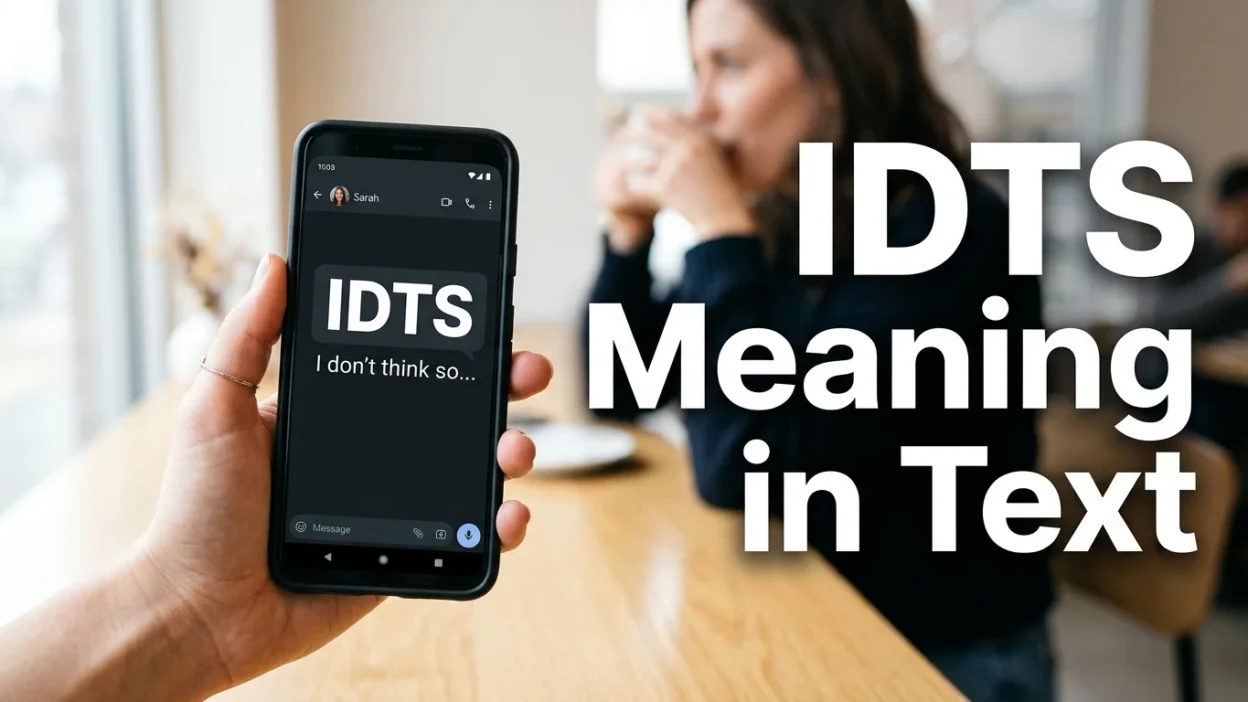
IDTS stands for “I Don’t Think So.” It’s used to express disagreement, doubt, or disbelief about something someone just said. It’s commonly used in texting, group chats, and social media comments.
What Does “IDTS” Mean?
IDTS is a text abbreviation that stands for “I Don’t Think So.”
In plain English, it’s a quick way of disagreeing with someone or expressing doubt about something they said. It works like a short, casual version of saying “I doubt it” or “probably not.”
The literal meaning comes directly from the phrase itself: “I” + “don’t” + “think” + “so,” shortened into four letters. There’s no hidden meaning behind it it’s simply a faster way to type a common response.
The most common way people use idts is as a quick reply to a question or statement, especially when someone is unsure or skeptical. For example, if a friend asks “Do you think it’ll rain today?”, you might reply “Idts, the sky looks clear.”
Meaning in Different Contexts
The core meaning of idts stays consistent everywhere, but the tone can shift slightly depending on the situation.
Everyday Conversation
In spoken conversation, people naturally say “I don’t think so” out loud, since idts is a written-only shortcut used mainly in texting.
Text Messages
Texting is where idts is used the most. It fits perfectly into fast, casual conversations where someone wants to express doubt without typing a full sentence.
Social Media
On platforms like Twitter/X and Reddit, idts often shows up in comment replies when someone disagrees with a claim, opinion, or prediction.
In WhatsApp chats, idts is common in group conversations, especially when friends are debating plans, opinions, or predictions about something.
Snapchat
Snapchat’s fast, casual messaging style makes idts a natural fit for quick replies expressing doubt or disagreement.
You’ll sometimes see idts in Instagram comments or DMs, usually reacting to a claim, poll, or opinion shared in a post or story.
TikTok
In TikTok comments, idts often appears when users disagree with something claimed in a video, like “Idts that’s actually true.”
Gaming
In gaming chats, players use idts to quickly express doubt about a strategy or claim, such as “Idts that plan will work.”
Professional Communication
IDTS is generally not recommended for professional emails or workplace messages. In formal settings, it’s better to write out “I don’t think so” or “I disagree” fully.
Internet Slang
As part of internet slang, idts belongs to a group of opinion-based abbreviations similar to idk (I don’t know) and imo (in my opinion), all designed to share quick reactions.
Examples of “IDTS”
Here are real-life examples showing how idts is used in actual conversations.
1. Sentence: “Do you think he’ll show up? Idts.” Meaning: Expressing doubt that someone will arrive. Situation: Casual texting between friends.
2. Sentence: “Is this restaurant still open? Idts, it’s pretty late.” Meaning: Expressing doubt about something being true. Situation: Making plans with friends.
3. Sentence: “Idts we’ll finish this project on time.” Meaning: Expressing doubt about meeting a deadline. Situation: Group chat discussing a school or work task.
4. Sentence: “Do you think it’s a good idea? Idts, honestly.” Meaning: Disagreeing with a suggestion. Situation: Friends discussing a decision.
5. Sentence: “Idts that movie is as good as everyone says.” Meaning: Expressing a differing opinion. Situation: Casual conversation about entertainment.
When Do People Use “IDTS”?
People use idts whenever they want to quickly express doubt, disagreement, or disbelief about something.
Common situations include:
- Responding to a question with uncertainty
- Disagreeing with someone’s opinion or claim
- Expressing doubt about plans or predictions
- Reacting skeptically to news or information
Who uses it: Teens and young adults use idts the most frequently, though it’s widely understood across most age groups familiar with texting slang.
Why people use it: It saves time and keeps replies short while still clearly communicating doubt or disagreement.
Appropriate situations: Texting friends, casual social media comments, and informal group chats.
Inappropriate situations: Professional emails, academic writing, or formal messages, where “I don’t think so” or “I disagree” should be spelled out fully.
Origin of “IDTS”
IDTS developed as part of the broader trend of texting abbreviations that grew out of early SMS and instant messaging culture in the early 2000s.
Since typing was slower and more limited on early mobile phones, people started shortening common phrases to save time and effort. Abbreviations like idk (I don’t know), imo (in my opinion), and idts followed a similar pattern of combining first letters from common expressions.
As texting and social media grew, these shortcuts carried over into everyday digital communication, including apps like WhatsApp, Instagram, and Twitter, where quick reactions and short replies are the norm.
There’s no single person or exact origin point credited with creating idts specifically. Like most internet slang, it developed naturally as people looked for faster ways to express doubt or disagreement in writing.
Similar Words and Alternatives
If you want variety instead of always typing idts, here are some alternatives.
- IDK (I Don’t Know): Expresses uncertainty rather than direct disagreement, slightly different in meaning.
- Doubt it: A short, casual alternative that carries the same meaning as idts.
- Probably not: A clear, slightly more formal alternative.
- I disagree: A more direct way to express disagreement, useful when clarity matters.
- Nah, idts: A combined casual phrase often used together for extra emphasis.
The main difference between idts and idk is the level of certainty. IDTS expresses doubt or disagreement about something specific, while idk simply expresses a lack of knowledge or opinion altogether.
Common Mistakes
Even though idts is simple, people sometimes misuse or misunderstand it.
Mistake 1: Using it in formal writing. IDTS should never appear in essays, resumes, or professional emails. Always write “I don’t think so” in full for formal communication.
Mistake 2: Confusing it with idk. Some people mix up idts with idk, but they mean different things. IDTS expresses doubt or disagreement, while idk expresses simply not knowing.
Mistake 3: Using it without context. IDTS works best as a direct reply to a specific question or statement. Using it randomly without something to disagree with can confuse the reader.
Tip to avoid confusion: If you’re texting someone unfamiliar with slang, such as an older relative or a non-native English speaker, it’s safer to spell out “I don’t think so” the first few times.
Frequently Asked Questions
What does idts mean in a text message?
IDTS means “I Don’t Think So.” It’s used to express doubt, disagreement, or disbelief about something.
Is idts the same as idk?
No, they mean different things. IDTS expresses doubt or disagreement about something specific, while idk simply means “I don’t know.”
Can I use idts in a professional email?
No, idts is too casual for professional communication. Use “I don’t think so” or “I disagree” instead in formal writing.
Where did idts come from?
IDTS developed from early texting and instant messaging slang, where people shortened common phrases to save time while typing.
Is idts appropriate to use with strangers?
It’s generally fine in casual online conversations, but if you’re texting someone new or unfamiliar with slang, spelling out “I don’t think so” is a safer choice.
Does idts have more than one meaning?
No, idts consistently means “I don’t think so” across texting, social media, and casual conversation.
How do I reply to a text that includes idts?
You can simply respond to the disagreement or doubt being expressed, either by explaining your reasoning further or accepting their point of view.
Conclusion
IDTS is a simple, widely used texting abbreviation that means “I Don’t Think So.” People use it to quickly express doubt, disagreement, or disbelief without typing a full sentence. You’ll find it everywhere from text messages and Instagram comments to TikTok replies and gaming chats.
While idts works well in casual, everyday conversations, it’s best avoided in professional or formal writing, where spelling out “I don’t think so” is more appropriate. Understanding texting abbreviations like idts helps you follow digital conversations naturally and communicate more clearly with friends, family, and online communities.

Hi, I’m Lucas Morgan, a writer at Meanhubz.com. I enjoy exploring words, phrases, idioms, and everyday expressions and explaining them in simple language. My goal is to create clear, engaging, and useful content that helps readers improve their English, understand meanings easily, and communicate with greater confidence every day.