
The business world is full of influential executives whose decisions shape companies, industries, and international markets. Some become famous by creating successful businesses, while others earn recognition by transforming established financial institutions. Hiroshi Mikitani and James Gorman represent these two different sides of global business leadership.
Hiroshi Mikitani is a Japanese entrepreneur best known for founding Rakuten Group, one of Japan’s major technology and e-commerce companies. His business journey began in the financial sector, but his ambition eventually led him to build an online marketplace that developed into a diversified international business ecosystem.
James Gorman is an Australian-born business executive who became widely recognized through his leadership at Morgan Stanley. He served as the company’s chief executive officer from 2010 to 2023 and helped expand its wealth management operations and financial services capabilities. In January 2025, he became chairman of The Walt Disney Company.
But what actually connects Hiroshi Mikitani and James Gorman?
Their connection is more interesting than a simple comparison of two successful business leaders. Companies associated with Morgan Stanley have participated in financial transactions involving Rakuten, including bond-related activities and a major debt tender offer. These transactions provide a documented institutional business connection between their corporate worlds.
However, there is an important distinction: a business relationship between two organizations does not automatically mean their executives are personal friends, direct business partners, or joint investors.
This article explores the Hiroshi Mikitani and James Gorman connection, their biographies, professional journeys, business achievements, leadership philosophies, and the relationship between Rakuten and Morgan Stanley. It also examines what entrepreneurs and business students can learn from their experiences.
Who Is Hiroshi Mikitani? Biography, Education, and Early Career
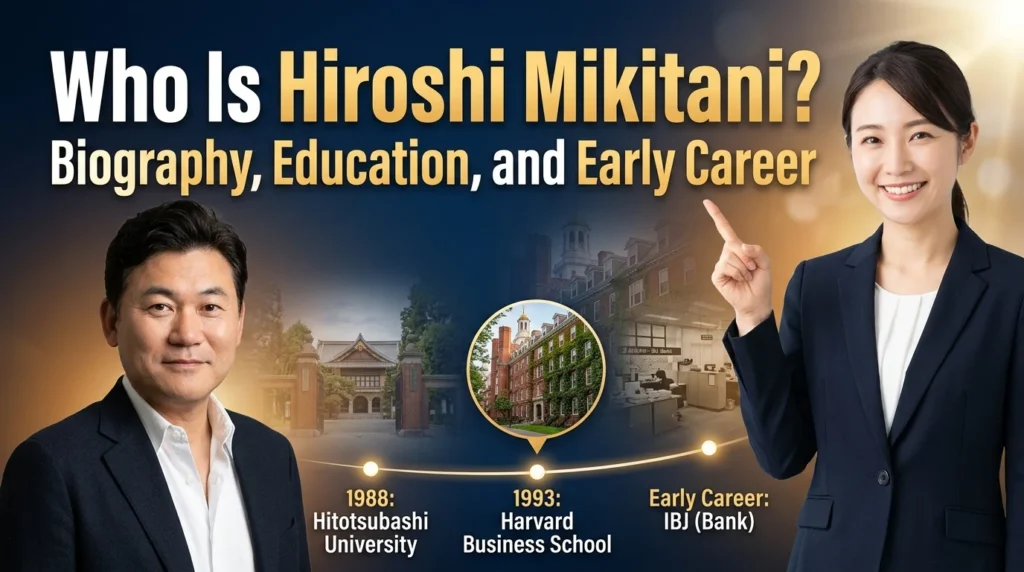
Hiroshi Mikitani is a Japanese entrepreneur, investor, and business executive. He is best known as the founder, chairman, president, and CEO of Rakuten Group.
Born on March 11, 1965, in Kobe, Japan, Mikitani developed an interest in business and economics before entering the corporate world.
His professional journey is particularly interesting because he did not begin as a technology entrepreneur. Instead, he started his career in banking before deciding to establish his own company.
Hiroshi Mikitani’s Education
Mikitani attended Hitotsubashi University in Tokyo, where he studied economics and graduated in 1988.
After university, he joined the Industrial Bank of Japan, which later became part of the Mizuho financial group.
His banking experience helped him understand financial markets, business financing, corporate structures, and the importance of long-term planning.
However, he wanted to develop a broader understanding of international business.
In 1993, he earned an MBA from Harvard Business School in the United States.
His time at Harvard exposed him to international business practices, entrepreneurship, and different approaches to building companies.
This education became an important foundation for his later entrepreneurial career.
From Banking to Entrepreneurship
Working in banking provided Mikitani with a stable professional career. However, he became increasingly interested in creating something of his own.
The mid-1990s represented an important period for the internet. Online communication and digital commerce were beginning to create opportunities that traditional businesses had not fully explored.
Mikitani recognized that the internet could change how businesses sold products and how customers discovered new companies.
He believed smaller merchants should have access to the same online marketplace opportunities as larger businesses.
Rather than spending his entire career in banking, he decided to take an entrepreneurial risk.
In February 1997, he founded Rakuten.
His decision marked the beginning of a business journey that would eventually make him one of Japan’s best-known technology entrepreneurs.
How Hiroshi Mikitani Built Rakuten Into a Global Business
Rakuten began as an online shopping marketplace in Japan.
Its original platform, Rakuten Ichiba, launched in May 1997 with a small number of merchants.
At that time, online shopping was still unfamiliar to many consumers and businesses. Internet speeds were relatively slow, and many retailers were uncertain about whether customers would purchase products online.
Mikitani saw an opportunity that traditional retailers were hesitant to explore.
Instead of creating a conventional online store, he developed a platform where independent merchants could establish their own digital shops.
This model gave businesses more control over how they presented products and communicated with customers.
It also helped smaller merchants reach consumers beyond their local markets.
The Rakuten Business Model
Rakuten’s business model developed around creating an ecosystem of services that could support one another.
Rather than depending only on e-commerce, the company gradually expanded into several industries.
Its major business areas include:
- E-commerce and online marketplaces.
- Digital banking and financial services.
- Securities and investment services.
- Mobile telecommunications.
- Digital entertainment.
- Travel services.
- Advertising and technology platforms.
The company also developed its loyalty ecosystem, including Rakuten Points.
Customers can earn and use loyalty points through participating services, creating an additional reason to remain within the Rakuten ecosystem.
This strategy connects different parts of the company and encourages repeat customer engagement.
Rakuten’s International Expansion
Mikitani wanted Rakuten to become more than a successful Japanese company.
The company expanded internationally through investments, acquisitions, and partnerships.
Its activities have included digital commerce, communications, financial technology, and other internet-based services.
Rakuten also developed operations in international markets through different business initiatives.
International expansion provided opportunities for growth, but it also introduced challenges.
Companies entering foreign markets must understand different customer preferences, regulations, competition, and operating costs.
Rakuten’s experience demonstrates that international growth requires more than simply transferring an existing business model into another country.
Rakuten’s Entry Into Telecommunications
One of the most ambitious decisions in Mikitani’s business career was entering Japan’s mobile telecommunications market.
Rakuten became Japan’s newest mobile network operator in 2019.
The company aimed to challenge established telecommunications providers by using modern network technology and developing a more technology-driven operating model.
This move required substantial investment in infrastructure, network development, and customer acquisition.
The telecommunications industry is difficult to enter because established competitors already have large customer bases and extensive infrastructure.
Rakuten’s entry therefore represented a major strategic challenge.
It also showed Mikitani’s willingness to explore industries beyond traditional e-commerce.
Hiroshi Mikitani’s Other Business Interests
Mikitani’s professional activities extend beyond online shopping and mobile telecommunications.
He has been involved in sports, entertainment, and biotechnology.
His business interests include Rakuten’s involvement with professional sports organizations in Japan.
He has also held leadership responsibilities connected with Rakuten Medical, a biotechnology company developing precision photoimmunotherapy.
These activities demonstrate how his entrepreneurial interests have expanded into different sectors.
His career is an example of business diversification, although each industry requires its own expertise, investment, and management strategy.
Who Is James Gorman? Biography, Education, and Career
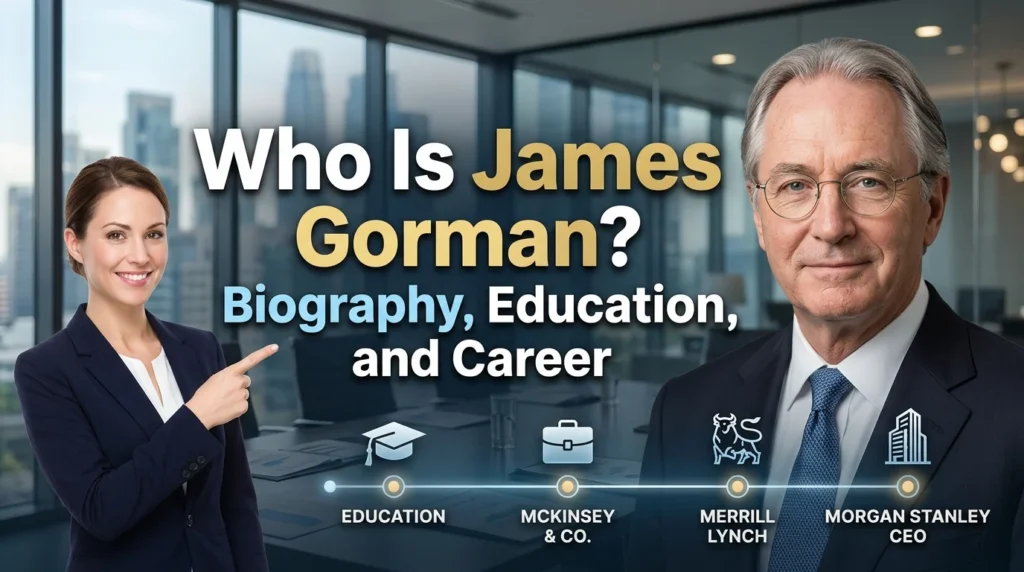
James P. Gorman is an Australian-born business executive who became internationally recognized for leading Morgan Stanley.
Unlike Hiroshi Mikitani, who founded a technology company, Gorman developed his career through law, management consulting, and financial services.
His professional journey demonstrates how experience in different industries can prepare someone for senior corporate leadership.
James Gorman’s Early Life and Education
Gorman studied at the University of Melbourne in Australia.
He earned bachelor’s and law degrees in 1982.
After completing his education, he began his professional career as an attorney in Melbourne.
However, he later decided to expand his knowledge of business and management.
In 1987, he earned an MBA from Columbia Business School in New York.
His education provided a foundation in finance, management, strategic planning, and corporate decision-making.
James Gorman’s Professional Career Before Morgan Stanley
Before joining Morgan Stanley, Gorman worked at McKinsey & Company, an international management consulting firm.
He became a senior partner and developed experience advising organizations on business strategy and management.
He later held executive positions at Merrill Lynch.
These roles provided valuable experience in financial services, client relationships, and corporate operations.
His combination of legal education, consulting experience, and financial industry knowledge helped prepare him for a leadership role at Morgan Stanley.
Joining Morgan Stanley
James Gorman joined Morgan Stanley in February 2006.
He became co-president in December 2007.
In January 2010, he was appointed chief executive officer.
In January 2012, he also became chairman of the company’s board.
These positions placed him at the center of one of the world’s major financial institutions.
His leadership period involved important changes in the financial industry, including technological developments, regulatory requirements, competition, and changing client expectations.
How James Gorman Transformed Morgan Stanley
Morgan Stanley is an international financial services company operating across investment banking, wealth management, institutional securities, and investment management.
When Gorman became CEO in 2010, the financial industry was still dealing with the consequences of the global financial crisis.
Financial institutions were under pressure to strengthen their business models, manage risk, and restore confidence among customers and investors.
Gorman’s leadership involved developing Morgan Stanley’s long-term business strategy and strengthening its different operating divisions.
Morgan Stanley’s Focus on Wealth Management
One of the most important developments during his leadership was the continued expansion of wealth management.
Wealth management involves helping individuals, families, and institutions manage their financial assets.
It can include investment advice, financial planning, portfolio management, and other services.
For Morgan Stanley, wealth management became an important part of its business strategy because it provided a different source of revenue from traditional investment banking.
This business also allowed the company to develop long-term relationships with clients.
The E*TRADE Acquisition
An important milestone in Morgan Stanley’s development was its acquisition of E*TRADE.
Morgan Stanley announced the transaction in February 2020 and completed it in October 2020.
E*TRADE brought digital brokerage capabilities and a substantial customer base into Morgan Stanley’s business.
The acquisition helped Morgan Stanley expand its position in digital investing and workplace financial services.
It also demonstrated how an established financial institution could strengthen its business by acquiring a technology-driven company.
The Eaton Vance Acquisition
Another important development was Morgan Stanley’s acquisition of Eaton Vance.
The transaction expanded Morgan Stanley’s investment management capabilities.
Investment management involves developing and managing investment products and portfolios for individual and institutional clients.
The acquisition supported Morgan Stanley’s strategy of expanding its financial services operations.
James Gorman’s Leadership Transition
Gorman served as Morgan Stanley’s CEO through December 2023.
Ted Pick succeeded him as CEO in January 2024.
Gorman then served as executive chairman from January through December 2024.
In January 2025, he became chairman emeritus of Morgan Stanley.
He also became chairman of The Walt Disney Company on January 2, 2025.
His move into Disney’s board leadership demonstrates how corporate executives can bring experience from one industry into another.
What Is the Actual Connection Between Hiroshi Mikitani and James Gorman?
This is the central question behind the keyword Hiroshi Mikitani and James Gorman.
Their connection should not be described simply as two executives having similar leadership styles.
There is a documented institutional relationship involving Rakuten and Morgan Stanley-related financial services organizations.
The important point is that Rakuten has participated in financial transactions in which Morgan Stanley entities played professional roles.
Two examples help explain this connection.
1. The 2014 Rakuten Bond Offering
In June 2014, Rakuten announced the terms of two unsecured bond offerings.
The first bond was intended for institutional investors, while the second was aimed at individual investors.
Rakuten’s official announcement listed Mitsubishi UFJ Morgan Stanley Securities Co., Ltd. among the underwriters for its first unsecured bond.
This is an important detail because it establishes a documented institutional connection between a Morgan Stanley-related securities business and Rakuten.
At the time, James Gorman was serving as chairman and CEO of Morgan Stanley.
However, this does not mean that Gorman personally negotiated the bond offering or directly advised Hiroshi Mikitani.
The documented fact is that a Morgan Stanley-affiliated securities company participated in the underwriting process.
2. The 2024 Rakuten Debt Tender Offer
A more direct institutional connection appeared in February 2024.
Rakuten announced cash tender offers involving two series of its US dollar-denominated senior notes due in 2024.
The company wanted to manage its outstanding debt and improve the maturity profile of its financial obligations.
Rakuten’s February 8, 2024 announcement identified Morgan Stanley & Co. LLC as one of the dealer managers for the tender offers.
Other dealer managers included Goldman Sachs, Daiwa Capital Markets America, and Mizuho Securities USA.
The tender offers were designed to allow eligible bondholders to sell their notes back to Rakuten under specified terms.
Rakuten later announced the results and final settlement of the offers on February 26, 2024.
This transaction is especially relevant to the Hiroshi Mikitani and James Gorman connection because Gorman was serving as Morgan Stanley’s executive chairman during 2024.
However, he had already stepped down as CEO at the end of 2023.
Therefore, the accurate explanation is that Morgan Stanley participated institutionally in Rakuten’s debt transaction during Gorman’s executive chairman period.
There is no verified public evidence establishing that Gorman personally managed the transaction or directly negotiated with Mikitani.
What Does This Business Connection Mean?
These transactions demonstrate how major companies interact through international financial markets.
Rakuten needed access to capital markets and financial services to manage its corporate financing.
Morgan Stanley and affiliated securities businesses provided professional services within this financial environment.
Such activities are common in international business.
Large companies frequently work with investment banks, securities firms, financial advisers, and other institutions when issuing bonds, managing debt, or conducting corporate transactions.
Therefore, the connection between Hiroshi Mikitani and James Gorman is best understood through their organizations’ involvement in the same financial and corporate environment.
It is an institutional business connection, not proof of a personal partnership.
Are Hiroshi Mikitani and James Gorman Direct Business Partners?
There is no clearly verified public evidence establishing that Hiroshi Mikitani and James Gorman are direct personal business partners.
Their professional careers are associated with different organizations.
Mikitani is the founder and leader of Rakuten Group.
Gorman is a former Morgan Stanley CEO and the chairman of The Walt Disney Company.
Their organizations have had documented institutional connections through financial transactions.
However, it is important to distinguish between three different concepts.
Institutional business relationship: Two companies work together through financial transactions, underwriting, or advisory services.
Personal business partnership: Two individuals directly establish or jointly operate a business relationship.
Professional similarity: Two executives have comparable experiences, leadership responsibilities, or business interests.
The Rakuten and Morgan Stanley transactions support the first category.
They do not independently establish the second.
This distinction makes the article more accurate and helps readers understand what actually connects these two executives.
Hiroshi Mikitani vs. James Gorman: Business and Leadership Comparison
Although they operate in different industries, comparing their careers helps explain their individual contributions to international business.
| Comparison | Hiroshi Mikitani | James Gorman |
| National background | Japanese | Australian-born |
| Main industry | Technology and e-commerce | Financial services |
| Major organization | Rakuten | Morgan Stanley |
| Main business role | Founder and CEO | Former CEO and chairman |
| Education | Hitotsubashi University and Harvard Business School | University of Melbourne and Columbia Business School |
| Career beginning | Banking | Law and consulting |
| Main business focus | Digital platforms and diversification | Financial services and wealth management |
| Major achievement | Building Rakuten | Leading Morgan Stanley |
| Leadership approach | Entrepreneurship and innovation | Corporate strategy and organizational development |
Entrepreneurial Leadership vs. Corporate Leadership
Mikitani’s career demonstrates entrepreneurial leadership.
He identified an opportunity in online shopping and established a company to serve a developing market.
His work involved building a business from the beginning, attracting merchants, developing technology, and expanding into additional industries.
Gorman’s career demonstrates corporate leadership.
He developed experience across several organizations before taking responsibility for Morgan Stanley.
His work involved managing an established financial institution, developing strategic priorities, overseeing acquisitions, and maintaining relationships with clients and shareholders.
Both careers require decision-making and long-term planning, but their responsibilities are different.
Innovation vs. Financial Strategy
Innovation has been central to Rakuten’s development.
Mikitani used digital technology to create an online marketplace and later expanded the company into other technology-driven services.
Gorman’s strategy focused on developing Morgan Stanley’s financial services capabilities.
His leadership included expanding wealth management and investment management through business development and acquisitions.
These approaches show that innovation and business transformation can take different forms.
A technology entrepreneur may create a new platform, while a financial executive may transform an established institution through strategic acquisitions and operational changes.
Risk Management and Business Growth
Both executives have worked in industries where major business decisions involve significant risks.
Rakuten’s expansion into telecommunications required substantial investment in network infrastructure and technology.
Morgan Stanley’s financial services operations require careful management of financial, operational, regulatory, and market risks.
Their careers illustrate that business growth is not simply about identifying opportunities.
It also requires evaluating risks, allocating resources, and managing long-term responsibilities.
The Leadership Philosophy of Hiroshi Mikitani
Hiroshi Mikitani’s leadership approach is closely connected to entrepreneurship and innovation.
His experience building Rakuten provides several examples of how business leaders can encourage organizational growth.
Encouraging Entrepreneurial Thinking
Mikitani’s original business idea was based on creating opportunities for merchants that did not have access to traditional large-scale retail networks.
This approach reflected his belief that technology could make business opportunities more accessible.
Entrepreneurial thinking remains important to Rakuten’s business identity.
Building a Connected Business Ecosystem
Instead of focusing on one industry, Mikitani expanded Rakuten into multiple services.
This strategy helped create connections between e-commerce, financial services, telecommunications, and digital entertainment.
The loyalty program also encourages customers to interact with different services within the same ecosystem.
Taking Calculated Business Risks
Entering telecommunications was a significant decision.
The company had to invest in technology and compete with established mobile operators.
This decision demonstrates Mikitani’s willingness to take substantial business risks when he sees an opportunity for long-term growth.
However, it also shows that diversification can create financial and operational challenges.
Thinking Internationally
Mikitani’s education and business activities helped develop an international perspective.
His work has involved global markets, international partnerships, and cross-border business development.
This perspective is increasingly important for technology companies that want to serve customers across different countries.
The Leadership Philosophy of James Gorman
James Gorman’s leadership experience reflects the demands of managing a large international financial institution.
His professional career provides several lessons about corporate strategy and organizational development.
Long-Term Strategic Planning
Financial institutions must balance immediate market conditions with long-term business objectives.
Gorman’s tenure involved strengthening Morgan Stanley’s wealth management operations and developing its overall business structure.
Strategic Acquisitions
The E*TRADE and Eaton Vance transactions demonstrate the importance of acquisitions in corporate growth.
Rather than developing every capability internally, large companies sometimes acquire businesses that provide technology, customers, or specialized expertise.
Managing Organizational Change
Large financial institutions operate under complex regulations and market conditions.
Their leaders must coordinate employees, business divisions, shareholders, customers, and regulators.
Gorman’s experience illustrates the importance of managing change while maintaining the stability of an established organization.
Leadership Succession
Gorman’s departure from the CEO position also highlights the importance of succession planning.
A company must prepare future leaders so that important operations and strategic priorities can continue after a leadership transition.
The transition to Ted Pick at Morgan Stanley provides an example of this process.
What Can Entrepreneurs Learn From Hiroshi Mikitani and James Gorman?
The careers of these two executives offer useful lessons for entrepreneurs, managers, business students, and professionals.
1. Recognize Opportunities Before the Market Changes
Mikitani recognized the potential of online shopping when many businesses were still uncertain about the internet.
This demonstrates the importance of identifying emerging opportunities.
Entrepreneurs should pay attention to changing customer needs, technology, and market conditions.
2. Build a Sustainable Business Model
Rakuten’s expansion into different services shows how businesses can develop multiple sources of revenue.
However, diversification should support the company’s main strategy rather than create unnecessary complexity.
3. Understand the Importance of Financial Management
Gorman’s career demonstrates the importance of financial planning, risk management, and business discipline.
Companies need strong financial management to support growth and maintain stability.
4. Use Strategic Partnerships
The institutional relationship between Rakuten and Morgan Stanley-related businesses demonstrates how organizations use external financial institutions to support corporate activities.
Businesses do not always need to develop every capability internally.
Working with qualified professional organizations can help companies access expertise and financial services.
5. Invest in Technology
Technology has become essential in almost every industry.
Rakuten built its business around digital platforms, while Morgan Stanley expanded its digital financial services capabilities.
Businesses that fail to understand technological changes may struggle to compete.
6. Prepare for Long-Term Leadership
Both careers demonstrate the importance of developing strong management structures.
Entrepreneurs should build organizations that can continue operating effectively as the business grows.
Corporate executives should also prepare future leaders and maintain clear succession plans.
Why Are People Searching for Hiroshi Mikitani and James Gorman?
The keyword may attract readers interested in business biographies, executive relationships, corporate transactions, and leadership comparisons.
There are several possible reasons behind this search.
Corporate business connections: Readers may want to understand the relationship between Rakuten and Morgan Stanley.
Financial transactions: The involvement of Morgan Stanley in Rakuten’s bond-related activities provides a specific reason to investigate the connection.
Business leadership: Both executives have led major international organizations, making their professional careers interesting subjects for comparison.
Entrepreneurship and finance: Mikitani’s journey from banking to entrepreneurship and Gorman’s development from consulting to financial leadership provide different examples of professional success.
International business research: Their careers demonstrate how companies and financial institutions interact across international markets.
The most useful way to understand the keyword is to examine both executives individually and then explain their documented institutional business connection.
Frequently Asked Questions About Hiroshi Mikitani and James Gorman
1. Who are Hiroshi Mikitani and James Gorman?
Hiroshi Mikitani is a Japanese entrepreneur and founder of Rakuten Group. James Gorman is an Australian-born business executive who served as CEO of Morgan Stanley from 2010 to 2023 and became chairman of The Walt Disney Company in January 2025.
2. What connects Hiroshi Mikitani and James Gorman?
Their documented connection is primarily institutional. Morgan Stanley-related securities businesses participated in Rakuten’s 2014 bond offering, and Morgan Stanley & Co. LLC acted as a dealer manager in Rakuten’s 2024 debt tender offers. Gorman held senior Morgan Stanley leadership positions during these periods.
3. Are Hiroshi Mikitani and James Gorman business partners?
There is no verified public evidence establishing a direct personal business partnership between them. Their companies have had institutional connections through financial transactions, but this does not prove that the executives personally worked together.
4. Did Morgan Stanley work with Rakuten?
Yes. Rakuten’s 2014 bond announcement listed Mitsubishi UFJ Morgan Stanley Securities among its underwriters. In February 2024, Morgan Stanley & Co. LLC was listed as a dealer manager for Rakuten’s cash tender offers involving US dollar-denominated senior notes.
5. Did James Gorman personally negotiate with Hiroshi Mikitani?
There is no verified public evidence establishing that James Gorman personally negotiated the Rakuten transactions or directly advised Hiroshi Mikitani.
6. What is Hiroshi Mikitani famous for?
Hiroshi Mikitani is famous for founding Rakuten in 1997 and developing it into a diversified technology and internet services company.
7. What is James Gorman famous for?
James Gorman is best known for leading Morgan Stanley as CEO from 2010 through 2023. He also became chairman of The Walt Disney Company in January 2025.
8. What companies are associated with Hiroshi Mikitani and James Gorman?
Hiroshi Mikitani is primarily associated with Rakuten Group. James Gorman is associated with Morgan Stanley, where he served as CEO and chairman, and The Walt Disney Company, where he serves as chairman.
9. Where did Hiroshi Mikitani study?
Hiroshi Mikitani studied at Hitotsubashi University in Japan and earned an MBA from Harvard Business School in 1993.
10. Where did James Gorman study?
James Gorman earned bachelor’s and law degrees from the University of Melbourne in 1982. He later received an MBA from Columbia Business School in 1987.
11. What is the main difference between Hiroshi Mikitani and James Gorman?
Mikitani is an entrepreneur who founded a technology and e-commerce business. Gorman is a corporate executive who developed his career in law, management consulting, and financial services before leading Morgan Stanley.
12. Is Hiroshi Mikitani still leading Rakuten?
According to Rakuten’s corporate leadership information, Mikitani remains its founder, chairman, president, and CEO.
13. Is James Gorman still the CEO of Morgan Stanley?
No. James Gorman stepped down as Morgan Stanley CEO at the end of 2023. Ted Pick became CEO in January 2024. Gorman became chairman emeritus in January 2025.
14. What business lessons can entrepreneurs learn from their careers?
Their careers highlight the importance of innovation, financial planning, customer relationships, strategic acquisitions, international expansion, and long-term business development.
Conclusion: The Real Business Connection Between Hiroshi Mikitani and James Gorman
Hiroshi Mikitani and James Gorman represent two different approaches to modern business leadership. Mikitani built Rakuten from an online shopping marketplace into a diversified international business ecosystem. His career demonstrates the power of entrepreneurship, digital innovation, business diversification, and the willingness to explore new industries.
Gorman developed his professional reputation through law, management consulting, and financial services. During his leadership at Morgan Stanley, the company expanded its wealth management capabilities and strengthened its position through important acquisitions.

Hi, I’m William Brooks, a writer at Meanhubz.com. I’m passionate about making English words, phrases, idioms, and expressions easy to understand. I create clear, accurate, and engaging content with simple examples to help students, writers, and English learners improve their vocabulary and communicate with greater confidence in everyday life.